(4 July 2026) – According to a news summary from the Global Anti-Scam Alliance (GASA), key global stakeholders gathered at the Global Anti-Scam Summit Europe 2026 in Lisbon, Portugal, under the overarching theme “Europe Against Scams: Public-Private Partnerships in Action.” The summit brought together representatives from government bodies, law enforcement, financial institutions, telecommunication providers, tech platforms, and consumer advocates to tackle the rising global scam epidemic. Organizers emphasized that modern scams operate as an interconnected chain across digital, financial, and telecom channels—meaning single-sector or isolated consumer protection strategies are no longer sufficient to disrupt organized crime networks.

A central focus of the conference keynotes was the urgent need to transition threat intelligence sharing from a theoretical commitment into an operational standard. Speakers outlined how cross-sector signals can be connected—such as telecom operators flagging impersonation attempts, tech platforms blocking fraudulent infrastructure, and banks stopping compromised payments mid-journey—to dismantle scams upstream before consumer losses occur. To make these joint efforts effective, participants stressed the need for common technical frameworks and clearer legal guidelines surrounding data protection, liability, and regulatory constraints.
The summit also dedicated significant discussion to the dual impact of artificial intelligence on the global fraud landscape. Criminal syndicates are increasingly utilizing agentic AI, synthetic content, deepfakes, and automated social engineering to make scams cheaper, faster, and far more convincing. Conversely, anti-fraud experts showcased how AI and machine learning are being deployed across defensive networks to enhance signal detection, automate threat response, and power unified consumer protection hubs such as GASA’s Global Signal Exchange and Scam.org.
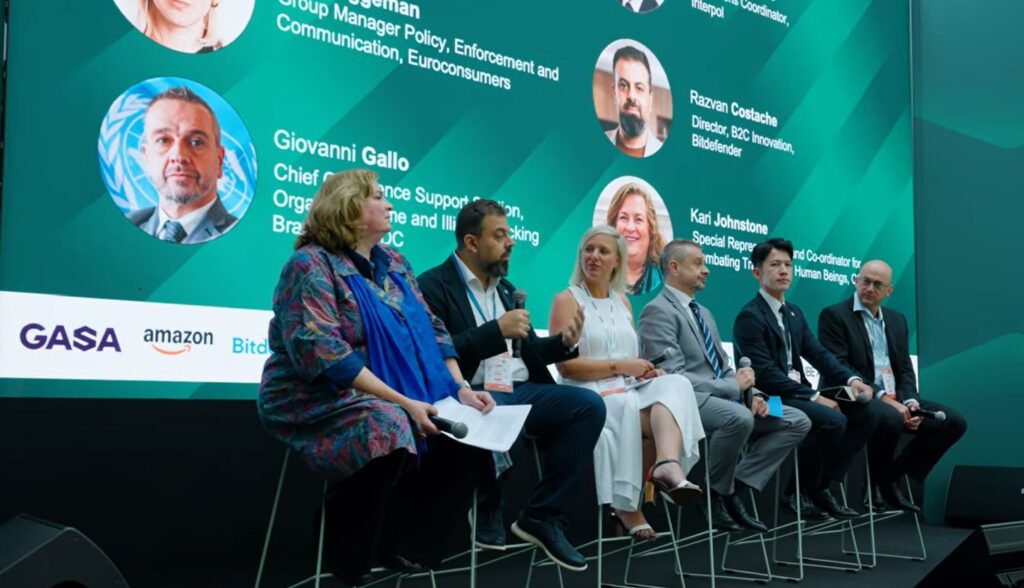
Concluding the event, GASA underscored that tackling transnational scams requires active, defined cross-industry commitments rather than superficial reporting. Highlights included Meta’s Industry Accord in Action workshop, updates from GASA’s specialized Working Groups, and the recognition of pioneering cross-sector initiatives through the Scam Fighter Awards. The takeaway was clear: building shared infrastructure, establishing bidirectional feedback loops, and aligning global policy are essential steps to increasing the cost for fraudsters and building a safer digital economy.
For a visual overview of the key moments and event highlights, check out the Global Anti-Scam Summit Europe 2026 Highlights. This video gives a quick recap of the Lisbon conference and highlights the major themes and cross-sector discussions surrounding global scam disruption.